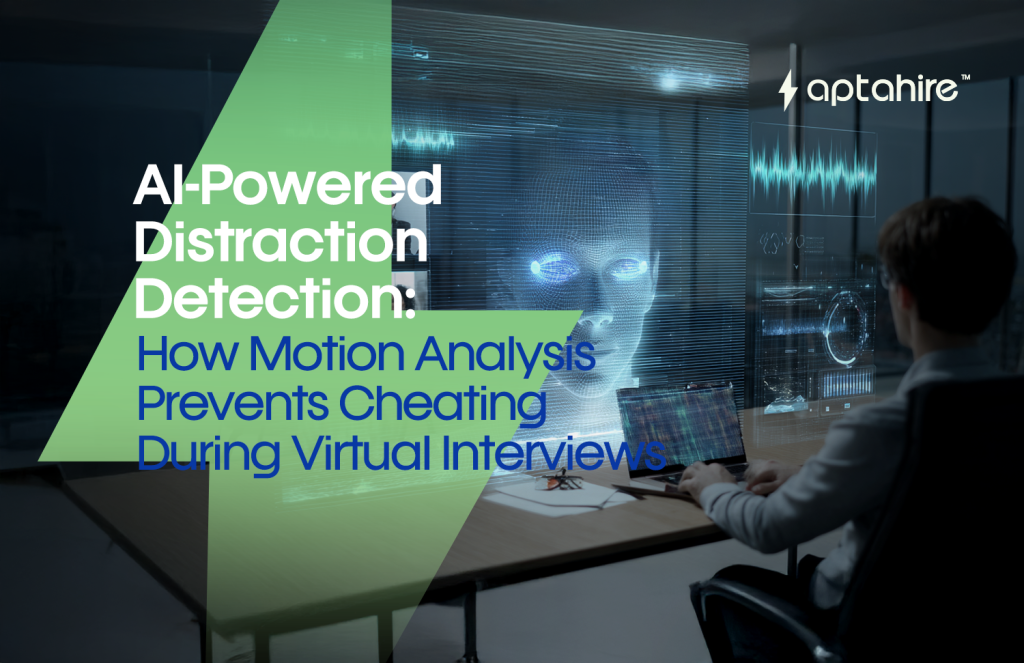
AI-Powered Distraction Detection: How Motion Analysis Prevents Cheating During Virtual Interviews
Imagine this: you’re running a virtual interview for a senior role. The candidate seems sharp, answers are quick, but you notice their eyes flickering to the side every few seconds. Sometimes they lean back, whisper something under their breath, or keep pausing before responding.
As a recruiter, doubts creep in, are they multitasking, reading from notes, or receiving external help?
This is a growing challenge in modern hiring. With 80% of companies now conducting at least part of their hiring process virtually (LinkedIn, 2024), the risks of distractions and dishonest practices have naturally multiplied. And when a bad hire can cost a company up to 30% of that employee’s annual salary (U.S. Department of Labor), the stakes are too high to ignore.
That’s where AI-powered distraction detection, specifically motion analysis, steps in to protect both recruiters and candidates.
What Exactly Is Distraction Detection in AI Hiring?
Distraction detection is an AI-driven process that tracks a candidate’s physical movements, eye patterns, and behavioral signals during a virtual interview. Instead of only listening to what candidates say, it observes how they act.
Think of it as having a second set of eyes in the room, sharp, unbiased, and data-driven, ensuring the conversation remains authentic.
It doesn’t mean every scratch of the nose or shift in the chair is suspicious. Instead, the AI looks for repeated, unusual behaviors that may suggest the candidate isn’t fully focused or may be getting outside help.
How Motion Analysis Works (Step by Step)
Let’s break down the process in simple terms:
- Facial and Eye Tracking
- The AI observes where the candidate is looking.
- Normal = occasional glances.
- Suspicious = constant looking off-screen, downward gazes (notes), or sideways eye movements (possible second screen or another person).
- Head and Body Positioning
- Leaning away from the camera repeatedly or turning sideways often may indicate multitasking.
- Continuous head tilts can suggest they’re listening to instructions from elsewhere.
- Background and Environment Monitoring
- Motion in the background is flagged, like another person walking in or sitting nearby.
- Detects sudden object movements (like checking a phone).
- Inactivity or Mismatch Detection
- If the candidate suddenly freezes, delays responses, or has mismatched audio-video cues, it may signal reliance on external sources.
- Pattern Recognition
- One-off actions are ignored (humans are natural movers!).
- AI looks for repeated, suspicious patterns across the interview.
The end result? Recruiters receive a distraction report highlighting potential anomalies, without disrupting the interview itself.
Why Does This Really Matter?
It’s fair to ask: “Isn’t this overkill? Do we really need AI to catch distractions?”
Here’s why it’s critical:
- Cheating in online assessments is real – Studies show over 30% of candidates admit to seeking outside help during virtual interviews or tests (SHRM, 2023).
- Remote hiring has higher risks – Without in-person observation, it’s easier for candidates to conceal multitasking.
- A fair system attracts better talent – Honest candidates prefer companies that value integrity.
- Prevents expensive mis-hires – Wrong hires not only cost money but also team morale and productivity.
Simply put: distraction detection isn’t about nitpicking, it’s about protecting the authenticity of the hiring process.
But Won’t Candidates Feel It’s Too Strict?
This is a common concern, and the answer lies in balance.
Distraction detection doesn’t penalize natural behavior. Everyone looks away occasionally, sips water, or shifts in their chair. What AI tracks is consistent, unusual activity that looks suspicious.
For example:
- Looking down once to jot a note = fine.
- Looking down every 15 seconds while typing = not fine.
It’s about context, frequency, and patterns. And importantly, AI doesn’t make the final call, recruiters do. AI simply provides insights to support human judgment.
Benefits for Candidates Too
At first glance, it may seem this tool is only for recruiters. But in reality, candidates benefit too:
- Equal Playing Field – Candidates know they aren’t competing with someone secretly getting external help.
- Recognition of Authentic Effort – Their genuine preparation shines without being overshadowed by dishonesty.
- Trust in the Process – They can feel confident that hiring isn’t biased or based on gut-feelings alone, but backed by objective analysis.
When candidates realize that honesty is rewarded, they’re more likely to engage authentically.
Where Is It Being Used Already?
Distraction detection isn’t futuristic, it’s already being applied across industries:
- Technology & IT – Ensures coders aren’t copying code or seeking help during assessments.
- Healthcare Hiring – Maintains fairness when evaluating doctors, nurses, or medical staff for roleplay-based scenarios.
- Education & Training – Keeps teaching role interviews authentic, since communication skills are key.
- Finance & Consulting – Prevents high-value role candidates from using unauthorized reference material mid-interview.
Wherever authentic decision-making under pressure matters, motion analysis ensures integrity.
The Future of AI-Powered Hiring
Distraction detection is just one layer in a growing AI toolkit for hiring:
- Voice Analysis – Detects stress, hesitation, or coached responses.
- Background Scanning – Flags inappropriate or unusual setups (multiple screens, extra people).
- Behavioral Insights – Helps recruiters understand personality fit and communication style.
The future is a hybrid one: AI + human recruiters working together. AI ensures fairness and objectivity, while humans bring empathy, intuition, and cultural understanding.
Final Thoughts
As virtual interviews become the new normal, companies face a dual challenge: making the process efficient while keeping it fair. AI-powered distraction detection with motion analysis is a smart solution.
It prevents cheating, protects fairness, boosts recruiter confidence, and even supports candidates who choose honesty over shortcuts.
At the end of the day, hiring is about finding the right fit for the role and the culture. By letting AI handle the distractions, recruiters can focus on what truly matters: human potential.
AI isn’t here to replace recruiters, it’s here to protect the integrity of hiring.
FAQs
1. What is AI-powered distraction detection in virtual interviews?
AI-powered distraction detection uses motion analysis to track a candidate’s eye movements, body language, and environment during virtual interviews to identify unusual patterns that may suggest multitasking or external help.
2. How does motion analysis work in detecting distractions?
Motion analysis observes facial cues, eye direction, body posture, and background activity. Instead of flagging every small movement, it detects repeated and unusual behaviors like frequent glances off-screen or continuous typing while answering questions.
3. Is distraction detection the same as surveillance?
No. It isn’t about spying or invading privacy. Distraction detection only analyzes visual cues captured during the interview itself and highlights suspicious patterns. Recruiters still make the final decision.
4. Why is distraction detection important in virtual hiring?
With most interviews happening online, cheating risks have increased. Distraction detection ensures fairness, prevents dishonesty, protects genuine candidates, and helps recruiters make more confident hiring decisions.
5. Will candidates be penalized for natural movements?
Not at all. The AI looks at patterns over time. Normal actions like sipping water, adjusting posture, or glancing once are ignored. Only consistent, unusual behaviors are flagged.
6. Does distraction detection benefit candidates too?
Yes. It levels the playing field by ensuring no one gets an unfair advantage. Authentic candidates who prepare genuinely can shine without being overshadowed by dishonest practices.
7. What industries use distraction detection in hiring?
It’s widely used in tech (to prevent coding help), healthcare (to ensure scenario-based authenticity), education (for teaching roles), and finance/consulting (to stop candidates from referencing unauthorized material mid-interview).
8. Is AI-powered distraction detection reliable?
Yes. While not 100% foolproof, AI systems are trained on vast datasets to identify suspicious patterns with high accuracy. And importantly, the recruiter always has the final say, not the AI.
9. How does distraction detection protect companies from bad hires?
By reducing the chance of candidates cheating their way through the interview, companies avoid mis-hires, which can cost up to 30% of the employee’s annual salary. It saves time, money, and team productivity.
10. What is the future of AI in virtual hiring?
Distraction detection is just the start. Future AI tools will also include voice stress analysis, background checks, and personality insights, working alongside recruiters to make hiring fairer, faster, and more reliable.